

TOGAF-Aligned Industrial Cloud Reference Model: A Blueprint for Scalable, Modern Manufacturing
Introduction: Why Industrial Cloud Needs a Blueprint

Cloud adoption in manufacturing is accelerating—but in many organizations, it remains fragmented, tactical, and disconnected from business outcomes.
When IT and OT operate in silos, the cloud becomes a cost center instead of a value engine.
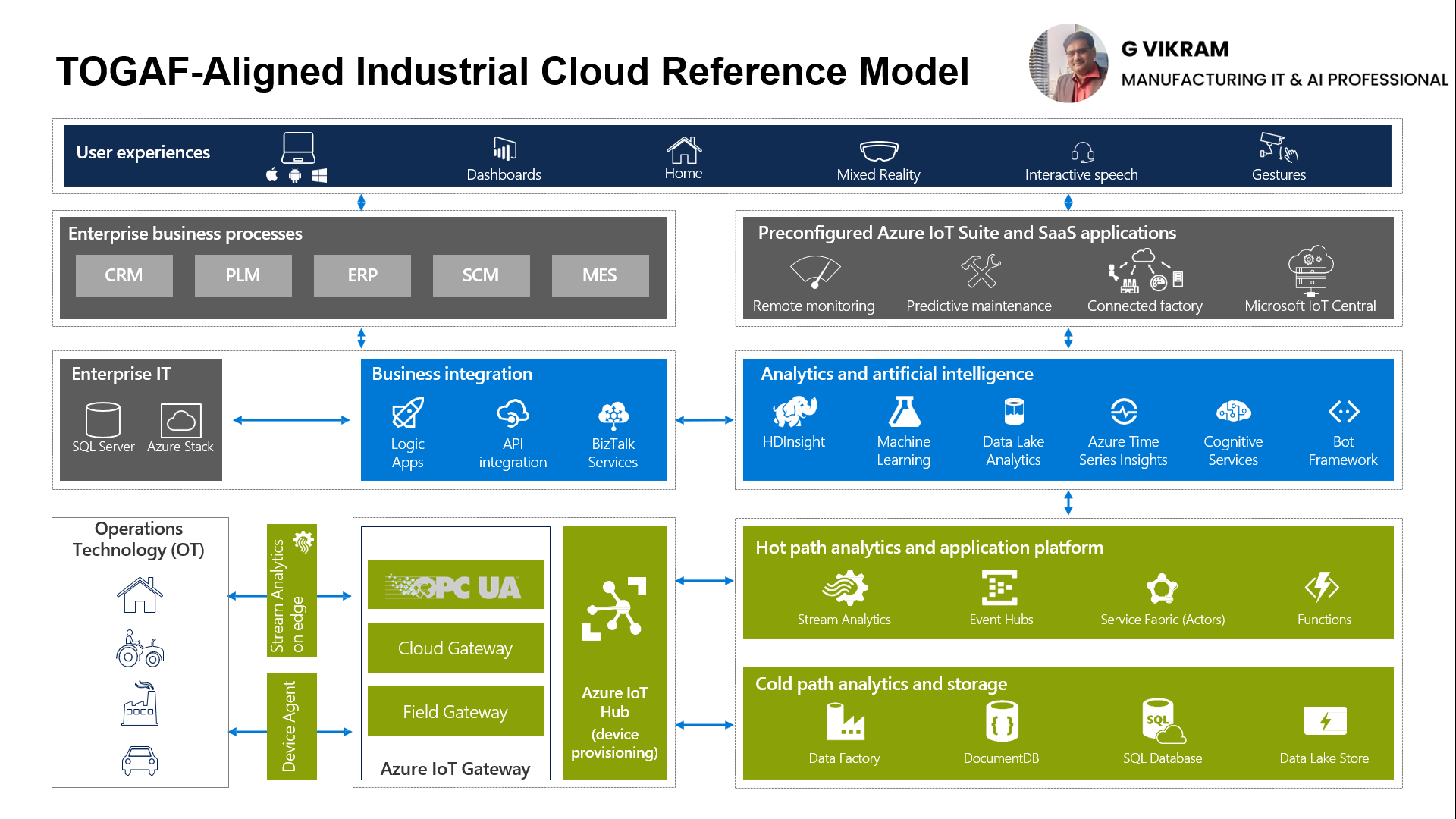
This edition introduces a TOGAF-Aligned Industrial Cloud Reference Model, created to help enterprises build structured, scalable, and strategically aligned cloud ecosystems.
It is a holistic, phased, and future-ready architecture designed for real manufacturing environments where IT–OT convergence, analytics, and business integration must come together.
🎯 The Need for a Structured Cloud Architecture
Leaders often ask:
“Which cloud services should we enable first?”
“How do we integrate OT, IT, and business systems?”
“How do we measure value at each stage?”
The answer:
Begin with a blueprint.
Advance layer by layer.
Optimize continuously.
The cloud is inherently flexible. Its true power emerges when each building block is introduced intentionally, in the right phase, with the right governance.
🔷 The TOGAF-Aligned Industrial Cloud Reference Model
This model aligns with TOGAF principles—business architecture first, technology architecture last—while remaining fully practical for real manufacturing needs.
The architecture spans five major layers, each representing a milestone in digital maturity.
Phase 1 — OT & Edge Foundation (Connected Operations Layer)
Before AI or analytics, factories need clean, trusted, continuous data.
Key capabilities:
Device Agents
OPC UA standardization
Edge Stream Analytics
Cloud/Field Gateways
IoT Hub provisioning
This phase ensures assets are connected securely and consistently.
Phase 2 — Cloud Integration Layer (Enterprise IT & API Layer)
Here IT systems begin communicating with OT.
Capabilities:
Logic Apps
API Integration
BizTalk Services
Hybrid workloads via SQL Server & Azure Stack
This is where operational workflows become digital workflows.
Phase 3 — Analytics & AI Enablement (Industrial Intelligence Layer)
Once data flows reliably, intelligence follows.
Includes:
Machine Learning
HDInsight
Data Lake Analytics
Azure Time Series Insights
Cognitive Services
Bot Framework
This phase enables predictive maintenance, quality analytics, and digital twins.
Phase 4 — Enterprise Systems & User Experience Layer
The value becomes visible across the organization.
Connected systems:
ERP, MES, SCM, CRM, PLM
Dashboards, Mobile, Mixed Reality
Interactive speech & gesture interfaces
This is where leadership begins to see measurable transformation.
Phase 5 — Industry Solutions & SaaS Accelerators
Finally, enterprises can scale with ready-made solutions:
Connected Factory
Remote Monitoring
Predictive Maintenance
Microsoft IoT Central
These accelerate ROI and reduce development overhead.
📌 Key Principles for Leaders
1. Build one layer at a time
Avoid “big-bang cloud transformation.”
Each layer must deliver value before the next is activated.
2. Use cloud flexibility to your advantage
Every service in the architecture can be adopted in a modular way.
Start small, scale fast.
3. Benchmark your maturity
Use this blueprint to assess:
Connectivity readiness
Integration maturity
Analytics capability
System convergence
Digital user experiences
4. Align cloud investments with business outcomes
Every spend must connect back to:
Throughput
Quality
Cost
Safety
Predictability
🔮 Closing Thoughts: The Future Is Layered and Cloud-Driven
Industrial organizations don’t fail due to lack of technology—they fail due to lack of architectural guidance.
A phased, TOGAF-aligned blueprint ensures:
✔ Predictable outcomes
✔ Reduced risk
✔ Sustainable scaling
✔ Better ROI
✔ Continuous optimization
This is the architecture of the future—flexible, modular, converged, and built for real industrial transformation.
Thank you