

The Missing Link Between Engineering and Manufacturing: Bill of Process (BOP)
Why high-performing factories are standardising their “language of execution”

Most factories don’t fail because of machines.
They struggle because engineering and manufacturing don’t speak the same language.
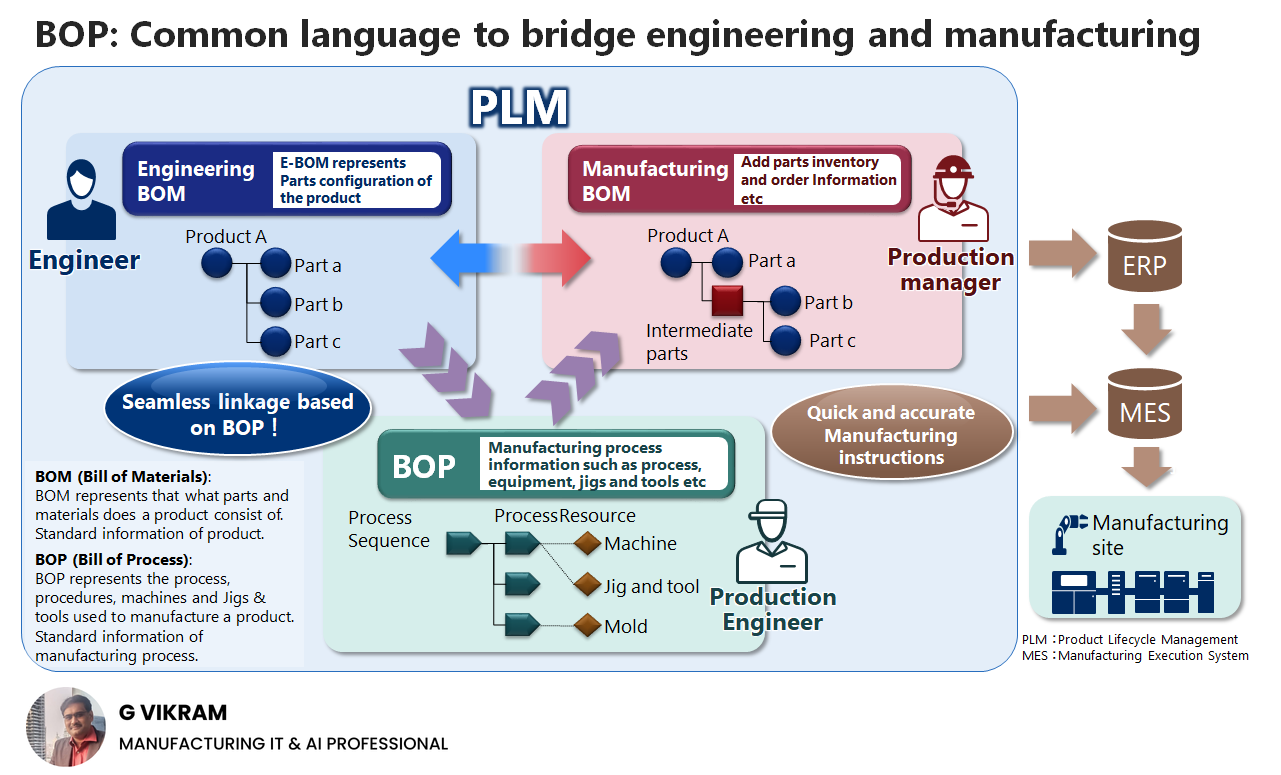
Engineering works with the Engineering BOM (E-BOM) – what the product is.
Manufacturing works with the Manufacturing BOM (M-BOM) – how the product is built.
Between the two, information gets lost in translation:
rework, delays, unclear work instructions, and painful engineering changes.
That’s where Bill of Process (BOP) comes in.
What Is BOP?
Bill of Process (BOP) is the structured model of how a product is manufactured.
It defines:
Process sequence
Machines and equipment
Jigs, fixtures, and tools
Molds and intermediate parts
The routing logic that turns a design into repeatable execution
In simple terms:
BOM defines what you build.
BOP defines how you build it.
Together, they create a digital backbone for modern manufacturing.
How BOP Bridges E-BOM and M-BOM
Today, many organisations still treat these as separate worlds:
PLM owns product definition (E-BOM).
Manufacturing / Operations owns routing and work orders (M-BOM + MES).
ERP handles planning, costing, and inventory.
Without a common model, every engineering change creates friction.
BOP acts as the “common language” across:
PLM – product structure and variants
ERP – material, planning, and cost structures
MES – operations, workflows, and work instructions
Manufacturing site – machines, tools, and people
Result: a single, consistent digital thread from design to execution.
Why BOP Matters in a Smart Factory
Adopting a Bill of Process model unlocks tangible benefits:
1. Faster, safer Engineering Change Management (ECM)
Changes in design flow into routings and work instructions with minimal manual effort.
Lower risk of obsolete or incorrect instructions reaching the shop floor.
2. Accurate, up-to-date manufacturing instructions
MES can generate clear, role-based work instructions directly from BOP.
Operators see what to do, on which machine, with which tools, every time.
3. Higher repeatability and quality
Standardised processes reduce variation between lines, shifts, and plants.
Easier to replicate best practices globally.
4. Stronger PLM–ERP–MES integration
BOP provides a process-centric view that all systems can reference.
Less duplication, fewer custom point integrations.
5. Foundation for Industry 4.0 and Industrial AI
Digital twins, advanced analytics, and AI copilots all depend on clean, structured process data.
BOP gives AI a precise understanding of how work actually happens.
Who Gains the Most?
Design & Product Engineers
Aligned process constraints early in the design cycle.Manufacturing / Production Engineers
A configurable model to manage machines, jigs, tools, and routing logic.Production Managers & Supervisors
Fewer surprises on the shop floor, smoother ramp-ups, and faster changeovers.IT / OT & Digital Teams
A stable information model to integrate PLM, ERP, and MES cleanly.Operators and Technicians
Clear, current, and context-aware instructions.
Practical Steps to Get Started with BOP
You don’t have to “boil the ocean”. A pragmatic path could look like this:
Start with a pilot product family
Choose one line or product where process complexity is high and pain is visible.Map the current process realistically
Capture actual process steps, machines, jigs, and tools—not just what’s on paper.Align E-BOM, M-BOM, and BOP
Create explicit links between product structure, manufacturing structure, and process steps.Integrate with MES for work instructions
Use BOP as the source for routings and electronic work instructions.Close the loop
Feed production feedback (rejects, changeovers, downtime) back into BOP for continuous improvement.
Key Takeaways
Most digital manufacturing problems are information problems, not technology problems.
BOP is the missing “language” that allows engineering intent to be executed consistently in manufacturing.
When BOP, BOM, PLM, ERP, and MES are aligned, you don’t just digitise your factory—you make it repeatable, scalable, and ready for Industrial AI.
Let’s Continue the Conversation
If you’re exploring:
PLM → MES integration
Setting up a digital thread for a new plant
Using AI on top of manufacturing data
I’d love to hear how you’re handling BOP today—or if it’s even defined yet in your organisation.
👉 Reply to this newsletter or connect with me on LinkedIn to share your experience or questions.