

The Industrial Data Illusion
Why Most Enterprises Still Struggle to Scale AI, DataOps, and Industry 4.0 Value

Most organizations believe they have a technology problem.
In reality, they have an architectural discipline problem.
That distinction changes everything.
Across manufacturing, energy, utilities, logistics, and industrial operations, enterprises are investing aggressively in:
AI platforms
Data lakes
Industrial IoT
Cloud modernization
Digital twins
Real-time analytics
Autonomous operations
Yet many leaders quietly admit the same reality:
“We still don’t trust the data.”
And that single sentence reveals the deeper issue.
The challenge is no longer access to technology.
The challenge is the absence of:
scalable operational architecture
semantic consistency
governance discipline
contextualized data foundations
enterprise-wide interoperability
Most organizations are not failing because they lack AI.
They are failing because they are trying to scale intelligence on top of fragmented operational ecosystems.
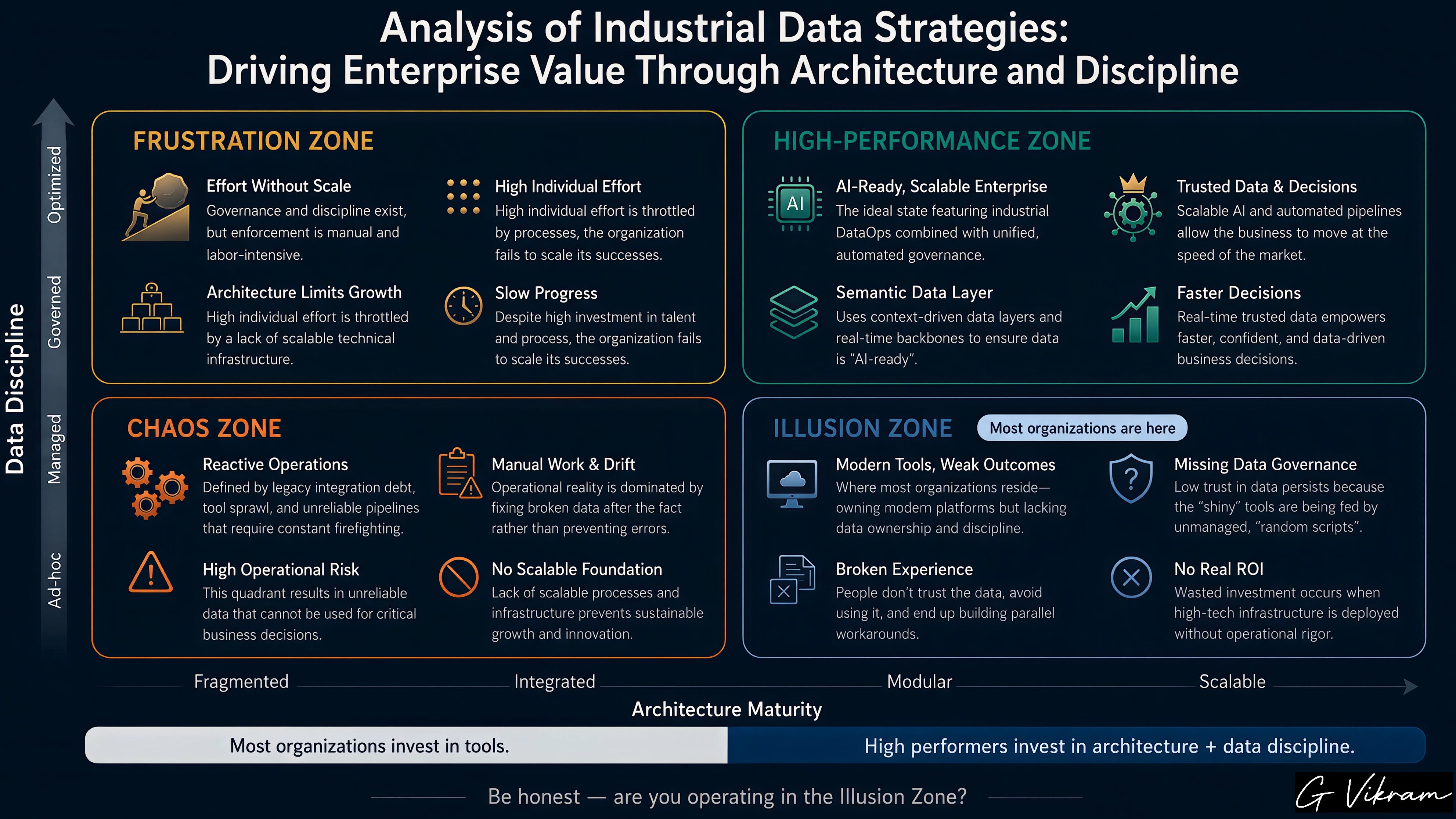
The Four Industrial Data Zones
The attached framework represents a pattern increasingly visible across industrial enterprises.
Not all organizations fail for the same reason.
Many are simply operating in different “data maturity zones.”
1. The Chaos Zone
“Technology exists, but operations are unstable.”
This is the starting point for many enterprises.
Characteristics:
siloed OT and IT systems
fragmented historians and MES deployments
disconnected ERP integration
spreadsheet-driven operations
reactive firefighting culture
unreliable pipelines
inconsistent tags and semantics
The organization spends most of its energy:
not optimizing,
but recovering.
Typical symptoms:
manual reconciliation
duplicated reports
low trust in KPIs
inconsistent production visibility
excessive engineering dependency
At this stage:
AI initiatives almost always fail.
Why?
Because AI amplifies operational inconsistency.
If the underlying operational signals are unstable,
AI simply scales confusion faster.
2. The Illusion Zone
“Modern tools. Weak outcomes.”
This is the most dangerous zone.
Because organizations here appear digitally advanced.
They own:
cloud platforms
AI pilots
modern dashboards
advanced analytics stacks
industrial data platforms
Yet business outcomes remain weak.
Why?
Because architecture maturity and governance discipline did not evolve alongside tooling investments.
This creates:
disconnected AI initiatives
duplicated data models
“random script” ecosystems
inconsistent business logic
low operational trust
The result is a phenomenon many leaders rarely discuss openly:
The Enterprise Data Illusion
Where:
dashboards increase
infrastructure costs rise
AI conversations intensify
…but operational decision quality barely improves.
This is where many enterprises currently reside.
Not because they lack ambition.
But because they optimized for:
technology acquisition
instead of:
operational architecture discipline.
3. The Frustration Zone
“The organization works hard, but cannot scale.”
This zone is common among enterprises with:
strong talent
serious governance intent
mature engineering teams
But scaling still stalls.
Why?
Because processes remain heavily dependent on:
individual expertise,
manual enforcement,
and organizational heroics.
Typical patterns:
governance exists on paper
architecture standards exist but adoption is inconsistent
teams work hard to maintain order
operational scalability remains limited
This creates:
high effort without enterprise acceleration.
The organization becomes:
competent,
but not composable.
And composability is essential for Industry 4.0 scale.
4. The High-Performance Zone
“Architecture becomes a competitive advantage.”
This is where industrial enterprises begin operating differently.
The transformation is not driven by dashboards.
It is driven by disciplined architecture.
Key characteristics include:
Unified Industrial Data Foundations
Operational data becomes:
contextualized
standardized
semantically aligned
reusable across systems
Scalable Governance
Governance becomes:
embedded
automated
operationalized
continuously enforced
Real-Time Operational Intelligence
Organizations reduce:
decision latency
integration friction
operational uncertainty
This enables:
trusted AI
autonomous workflows
faster decision cycles
scalable analytics
enterprise-wide interoperability
At this stage,
AI finally becomes transformational.
Because the enterprise is no longer fighting its own architecture.
The Real Industry 4.0 Divide
The future divide in manufacturing will not be:
AI vs non-AI companies.
It will be:
Architecturally disciplined enterprises
vs
architecturally fragmented enterprises.
That is the real competitive boundary emerging globally.
The organizations that win will not necessarily have:
the largest AI budgets
the most dashboards
the most pilots
They will have:
the cleanest operational semantics
the strongest interoperability
the lowest decision latency
the highest trust in operational data
Because trusted intelligence compounds.
Fragmented intelligence collapses.
Why This Matters More in the AI Era
AI is changing the economics of operational execution.
But AI also exposes organizational weaknesses faster than any previous technology wave.
Without disciplined architecture:
AI scales inconsistency
automation accelerates errors
copilots amplify bad context
analytics increase confusion
This is why many organizations feel:
“stuck in pilot mode.”
The issue is rarely the model.
The issue is the enterprise foundation beneath the model.
The Strategic Shift Leaders Must Make
The next decade of industrial transformation will require leaders to move from:
❌ Tool-centric thinking
to
✅ Architecture-centric thinking
From:
❌ isolated AI projects
to
✅ operational intelligence ecosystems
From:
❌ dashboard proliferation
to
✅ trusted decision systems
From:
❌ fragmented integration
to
✅ semantic interoperability
From:
❌ reactive governance
to
✅ embedded data discipline
Final Thought
Most organizations are investing in tools.
High-performing enterprises invest in:
architecture + data discipline.
And that may become the single most important differentiator of the Industry 4.0 era.
Because eventually:
AI maturity
will be limited by
architecture maturity.
Not model sophistication.
📌 The hardest question leaders should ask is not:
“Do we have AI?”
But:
“Can our operational architecture support trusted, scalable intelligence?”
That question determines whether an enterprise becomes:
truly autonomous,
or permanently trapped in the Illusion Zone.