

🧭 The Enterprise Guide to Evaluating GenAI Architecture
A Practical Blueprint for CIOs, CDOs, Digital Leaders & Transformation Teams

👉 GenAI is no longer about chatbots — it is about orchestrating intelligence across the enterprise.
The reference architectures emerging today show a fundamental shift:
from single-model experiments → to multi-agent, multi-layer GenAI ecosystems that must interact with core IT, business workflows, governance systems, and cloud services.
This newsletter breaks down what truly matters when evaluating a GenAI architecture for enterprise use.
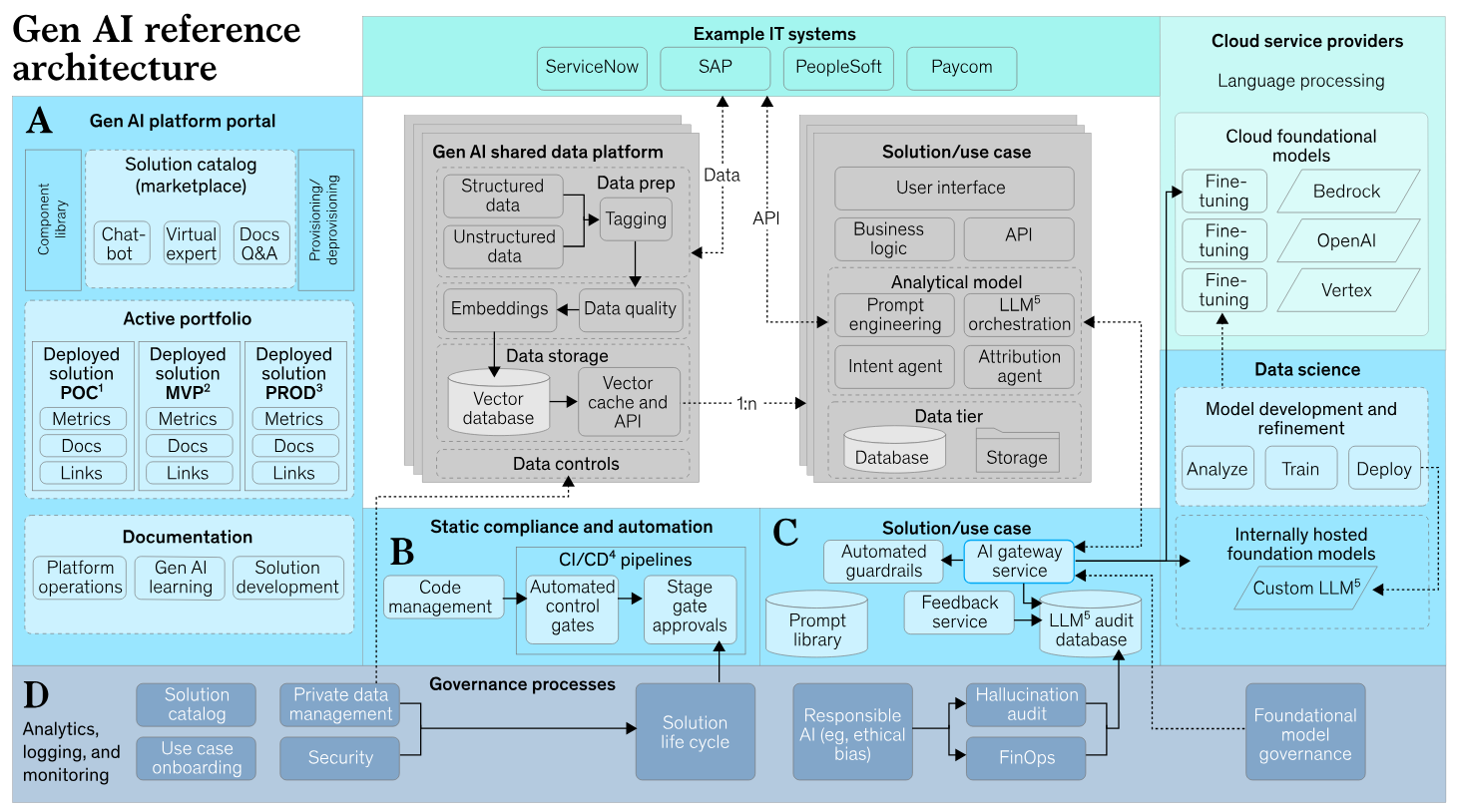
🧩 Why GenAI Architecture Matters More Than the Model Itself
Success with GenAI doesn’t come from picking the “best LLM” — it comes from building the right:
Foundation (data & infra)
Intelligence layer (models, agents, orchestrators)
Governance & guardrails
Integration fabric with enterprise systems
Continuous learning pipelines
A well-designed GenAI architecture becomes a strategic business engine, not a one-off AI project.
🔍 The GenAI Architecture Evaluation Blueprint
Before adopting or scaling GenAI, ask these essential questions:
1️⃣ Can It Orchestrate Intelligence Across the Enterprise?
The architecture must support:
Multi-agent collaboration
Workflow automation
Prompt chaining
Enterprise-wide action execution
If the system cannot act, it cannot transform.
2️⃣ Does It Integrate Seamlessly with Core IT Systems?
A GenAI layer must connect with:
SAP
ServiceNow
PeopleSoft
Paycom
Custom ERP / MES
Legacy on-premise systems
Without deep integration, GenAI becomes an isolated tool — not an enterprise accelerator.
3️⃣ Are Guardrails, Audits & Controls Built-In?
Modern architectures must include:
Automated policy enforcement
Content & action validation
Ethical & hallucination audits
Role-based access
Data privacy & compliance systems
Governance must be embedded, not an afterthought.
4️⃣ Does It Support Multiple Model Strategies?
Ask whether your architecture can support:
Foundation models (OpenAI, Bedrock, Vertex, Azure)
Fine-tuning & RAG
Custom domain-specific models
Hybrid on-prem + cloud deployment
A flexible model strategy protects you from vendor lock-in.
5️⃣ Is There a Continuous Feedback Loop?
Enterprise GenAI must learn continuously through:
Human-in-the-loop review
Reinforcement from outcomes
Intent correction
Error tracing back to the model
Without feedback loops, GenAI becomes stale — and unreliable.
6️⃣ Is Governance Built End-to-End?
Governance must cover:
Data lineage
Model lifecycle
Access & permissions
MLOps / LLMOps
Risk, ethics & compliance
A strong governance layer is what makes GenAI safe, scalable, and enterprise-ready.
🧠 The Bottom Line
For CIOs, CDOs, CX leaders, and transformation teams:
GenAI is not a chatbot.
GenAI is an enterprise nervous system — one that sees, reasons, acts, and improves.
Choosing the right architecture determines whether your AI initiatives stay in pilots…
or mature into enterprise-wide competitive advantage.
💬 Final Thoughts
If you’re evaluating GenAI platforms, architectures, or internal AI programs, start with this simple truth:
👉 A scalable GenAI architecture = models + integrations + governance + continuous learning.
Get these pillars right, and you unlock exponential value.
Thank you