

🏭 Securing the Industrial Future - The Blueprint for OT Security Architecture
🔐 The New Industrial Frontier

The line between IT, OT, and IoT is blurring — and with it, traditional security boundaries.
As factories modernize and supply chains digitize, blended cyberattacks are becoming the norm, exploiting weak integration points between data, control, and physical systems.
To safeguard this evolving landscape, organizations need more than firewalls and patches — they need a unified architectural approach.
This is where the Operational Technology (OT) Security Reference Architecture becomes essential — a blueprint built on Zero Trust principles that integrates safety, security, and business agility into a single digital framework.
⚙️ The Drivers Behind the Shift
Industrial leaders are accelerating digital transformation for three key reasons:
Business Efficiency: Data-driven agility that reduces downtime and improves throughput
Governance & Regulatory Compliance: Alignment with safety and security standards such as CMMC
Emerging Security Standards: Rising expectations for interoperability, resilience, and auditability
However, transformation without protection introduces unacceptable risk.
Every connected machine becomes a potential breach vector unless protected under a modern, layered, and continuously verified architecture.
🧩 The Architectural Blueprint
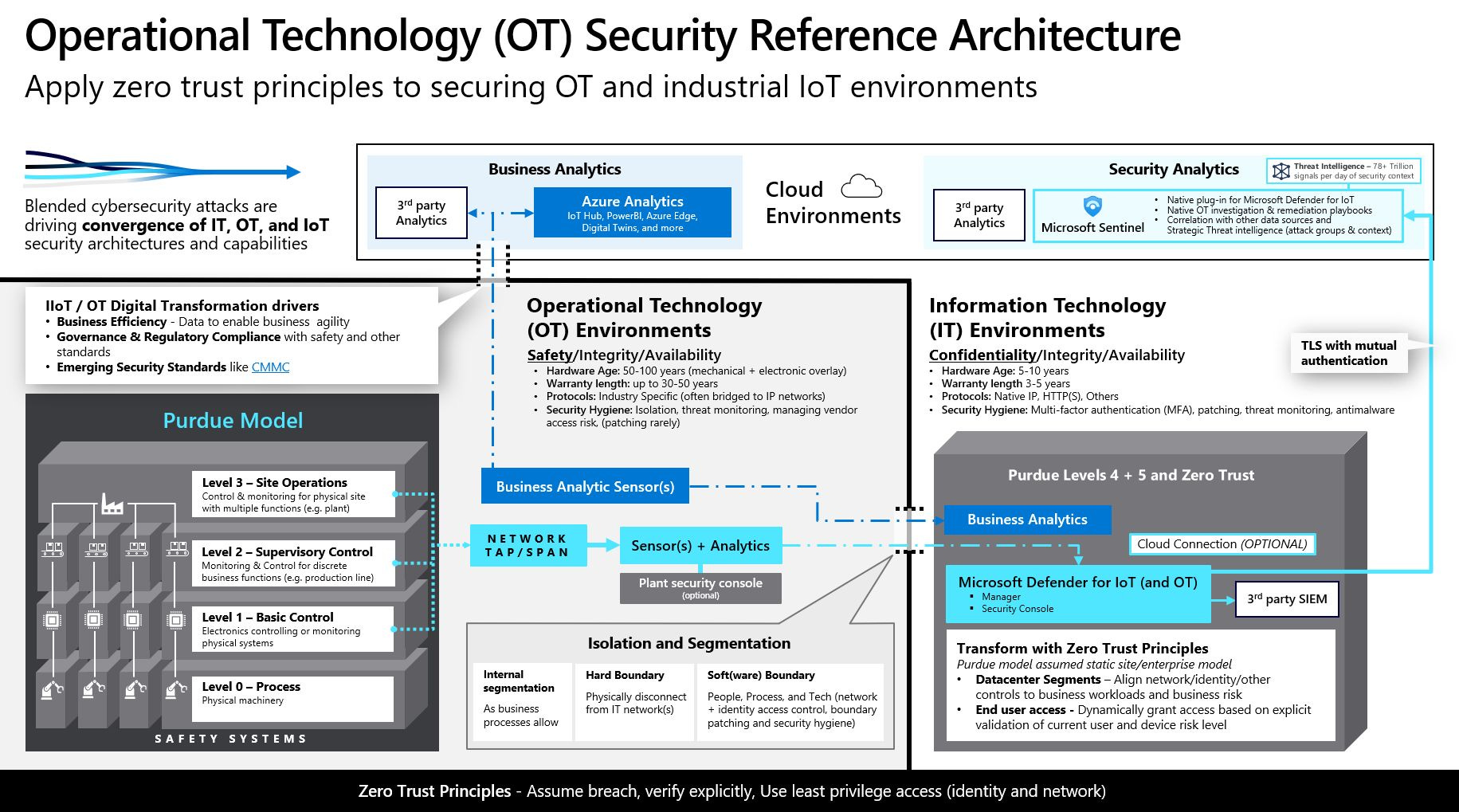
The reference model outlines how Information Technology (IT) and Operational Technology (OT) environments can securely converge through layered defense, segmentation, and intelligent analytics.
1️⃣ Operational Technology (OT) Environments
Focus: Safety, Integrity, and Availability
Hardware lifecycle: 50–100 years
Protocols: Industry-specific, IP-bridged networks
Hygiene: Isolated, infrequent patching, vendor-access control
2️⃣ Information Technology (IT) Environments
Focus: Confidentiality, Integrity, and Availability
Hardware lifecycle: 3–5 years
Security: MFA, patching, continuous threat monitoring
TLS with mutual authentication for cross-domain trust
3️⃣ Cloud and Security Analytics
The architecture integrates Azure Analytics, Power BI, and Digital Twins for scalable insights, while Microsoft Sentinel and Defender for IoT provide:
Threat correlation across IT/OT/IoT layers
Automated remediation playbooks
Attack group context via 78+ trillion daily security signals
4️⃣ Isolation and Segmentation
Security boundaries are enforced both physically and logically:
Hard Boundaries: Physical disconnects between IT and OT networks
Soft Boundaries: Policy-driven segmentation using identity, process, and risk-based access
5️⃣ Zero Trust Transformation
At the heart of the model lies Zero Trust — built on three unshakable principles:
Assume breach. Verify explicitly. Use least-privilege access.
This transforms static site models into adaptive, risk-aware architectures — validating every user, device, and workload continuously.
🧱 The Purdue Model Reimagined
The architecture builds on the Purdue Enterprise Reference Model, redefining each layer through the Zero Trust lens:
Levels 0–3: OT process control, sensors, and safety systems
Levels 4–5: IT and business operations integrated with analytics, governance, and defense
This layered structure ensures end-to-end visibility and control, from the production floor to the cloud edge.
🚨 Why It’s a Strategic Imperative
This architecture is more than cybersecurity — it’s operational resilience.
It protects not just systems and data, but also the decision-making fabric of the smart factory.
Without such frameworks, digital transformation risks becoming a collection of siloed initiatives with hidden vulnerabilities.
With it, organizations achieve:
Unified threat visibility across IT and OT
Compliance with evolving regulations
Long-term asset protection and operational trust
💡 The Takeaway
Industrial cybersecurity isn’t an add-on — it’s the foundation of digital transformation.
By embedding Zero Trust principles into the Purdue Model, organizations can build factories that are not just connected — but consciously secure.
“Security by design is not a feature; it’s the future of manufacturing intelligence.”
🧭 Your Next Step
If you’re charting your smart manufacturing roadmap, begin with this question:
👉 “Do our IT, OT, and IoT systems trust each other too much?”
Start with segmentation, enforce verification, and scale with analytics-driven visibility.
That’s how resilient enterprises are built — brick by digital brick.
📰 Closing Thought
This blueprint sets a new industry benchmark — a model for aligning technology, security, and governance across the connected industrial ecosystem.
Because in the age of convergence, trust isn’t assumed — it’s engineered.
Thank you