

🚀 Microsoft Ignite 2025: Security Copilot Is Transforming SecOps as We Know It
A new era of accessible, AI-driven security for every organization — including manufacturing.

Welcome back to the newsletter!
This week, we dive into one of the most significant announcements from Microsoft Ignite 2025: the evolution of Microsoft Security Copilot into a fully operational, multi-agent SecOps ecosystem.
This is not just another product update.
It is a shift in how cybersecurity will be delivered, operated, and democratized across industries.
🔥 The Big Reveal: Security Without Complexity
For years, organizations have struggled with the rising cost and complexity of security operations.
High skill requirements, talent shortages, increasing alert volumes, and fragmented tools created an environment where only large enterprises could run effective SecOps.
Not anymore.
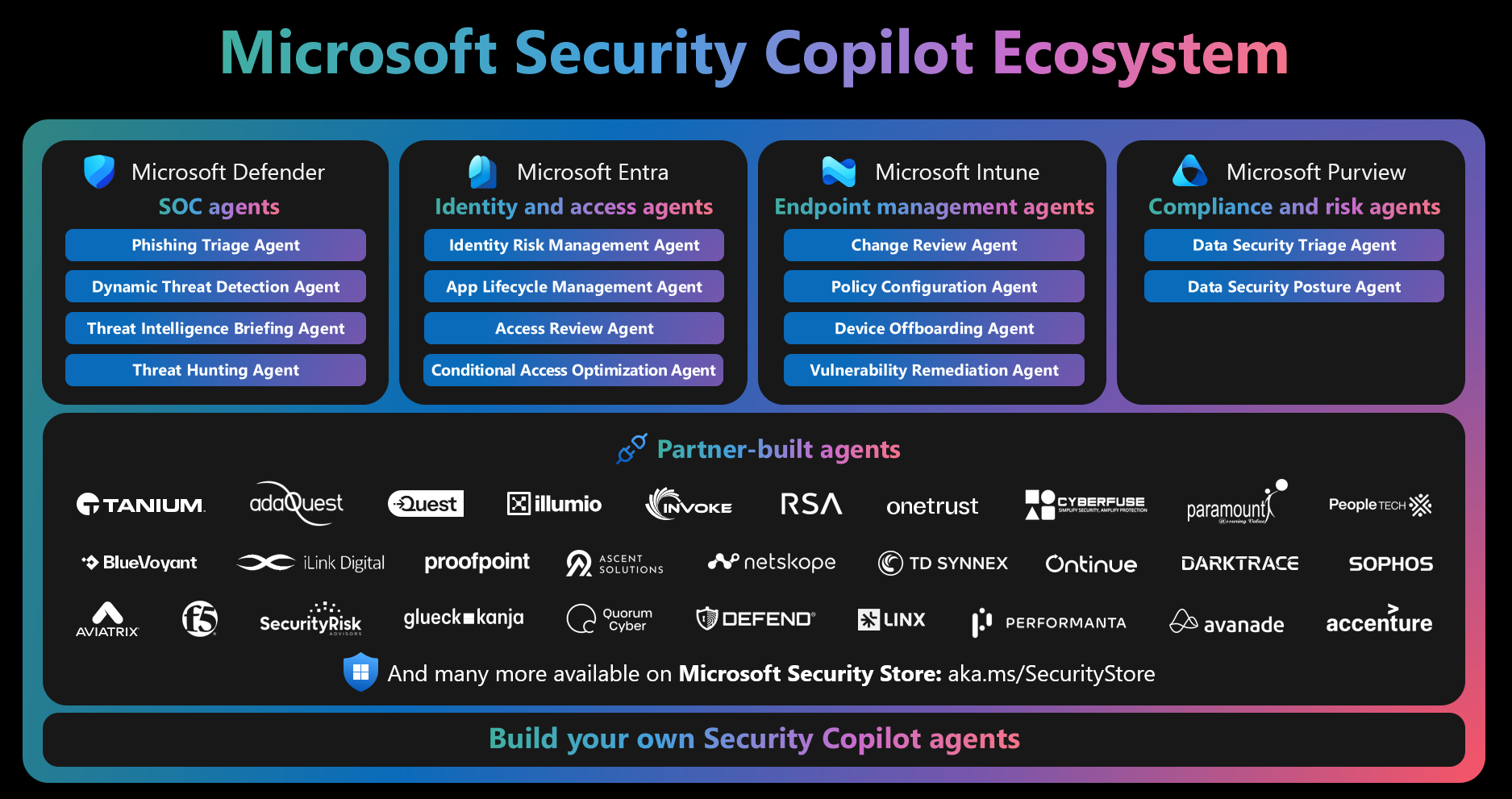
At Ignite 2025, Microsoft demonstrated an expanded Security Copilot Ecosystem that brings together:
SOC Agents for triage, threat detection, hunting, and intelligence
Identity & Access Agents for risk assessment and lifecycle operations
Endpoint Management Agents for policy, device actions, and vulnerability remediation
Compliance & Risk Agents for posture analysis, governance, and data protection
What makes this special is not just the automation —
it’s the operational intelligence packed into each agent.
💡 Security That Anyone in IT Can Operate
The most striking part of the announcement:
Security Copilot’s workflows are designed so well that even non-security professionals can understand, interpret, and act on them.
For many industries, this is a breakthrough.
Today’s IT teams often wear multiple hats — network, applications, cloud, endpoints, identity.
Security becomes an “extra” responsibility they can barely support.
Security Copilot changes this dynamic by offering:
Guided investigations
Automated remediation plans
Natural language insights
Context-aware summaries
Cross-agent coordination
The result?
Security moves from specialist-driven to organization-driven.
A shift that has been long overdue.
🏭 Why This Matters for Manufacturing
Manufacturers face unique challenges:
Distributed plants
Legacy machines connected to modern networks
Limited cybersecurity staff
High-stakes operational risks
Rapid deployment of IoT and automation systems
Until now, building a full SecOps capability was unrealistic for many manufacturing organizations.
With Security Copilot:
A generalist IT engineer can run daily SecOps workflows
Threats can be triaged automatically
Endpoint issues can be resolved with guided or autonomous actions
Identity risks can be analyzed without deep IAM knowledge
Compliance posture can be monitored continuously
This is security at the speed of manufacturing, not security slowed down by complexity.
⚙️ Microsoft’s Bigger Vision:
Making sophisticated technology simple, intuitive, and universally accessible.
Whether it was Cloud, Azure AI, Copilot Studio, or today’s Security Copilot ecosystem —
Microsoft continues to make complex enterprise capabilities usable by everyone, not just experts.
This democratization is crucial, especially now:
Cyberattacks are increasing
Talent shortages persist
IT workloads are expanding
Operational risks are rising
Manufacturing is digitizing rapidly
The future of SecOps cannot depend solely on scarce human expertise.
It must be AI-accelerated, workflow-guided, and context-aware.
🌐 The New Direction of SecOps
Security Copilot lays down a clear vision:
Accessible. Automated. AI-driven. Integrated.
Every organization — from large enterprises to mid-market manufacturers — can now:
Strengthen security posture
Reduce operational burden
Respond faster
Improve clarity and reporting
Operate with confidence
without needing a fully staffed CyberOps team.
🧭 Final Thoughts
Microsoft Ignite 2025 signals a major turning point.
SecOps is no longer an elite function reserved for large security teams.
It’s becoming:
Operationally simple
AI-guided
Integrated into everyday IT
Available to industries that couldn’t afford specialized talent
For manufacturing and industrial sectors, this could be the moment that finally closes the cybersecurity readiness gap.
The future is here —
and it’s secure, automated, and accessible to all.