

🏗️ Microsoft Azure Cloud Administration Model
Understanding Governance Before You Build the Cloud

Before a single VM, database, or application goes live in Azure, every organization must understand how the cloud is governed, structured, and managed.
The Azure Cloud Administration Model provides the enterprise-wide blueprint for how identity, governance, and operations come together.
For newcomers and even experienced professionals, this model defines the why and how of organizing your Azure environment before technical deployment begins.
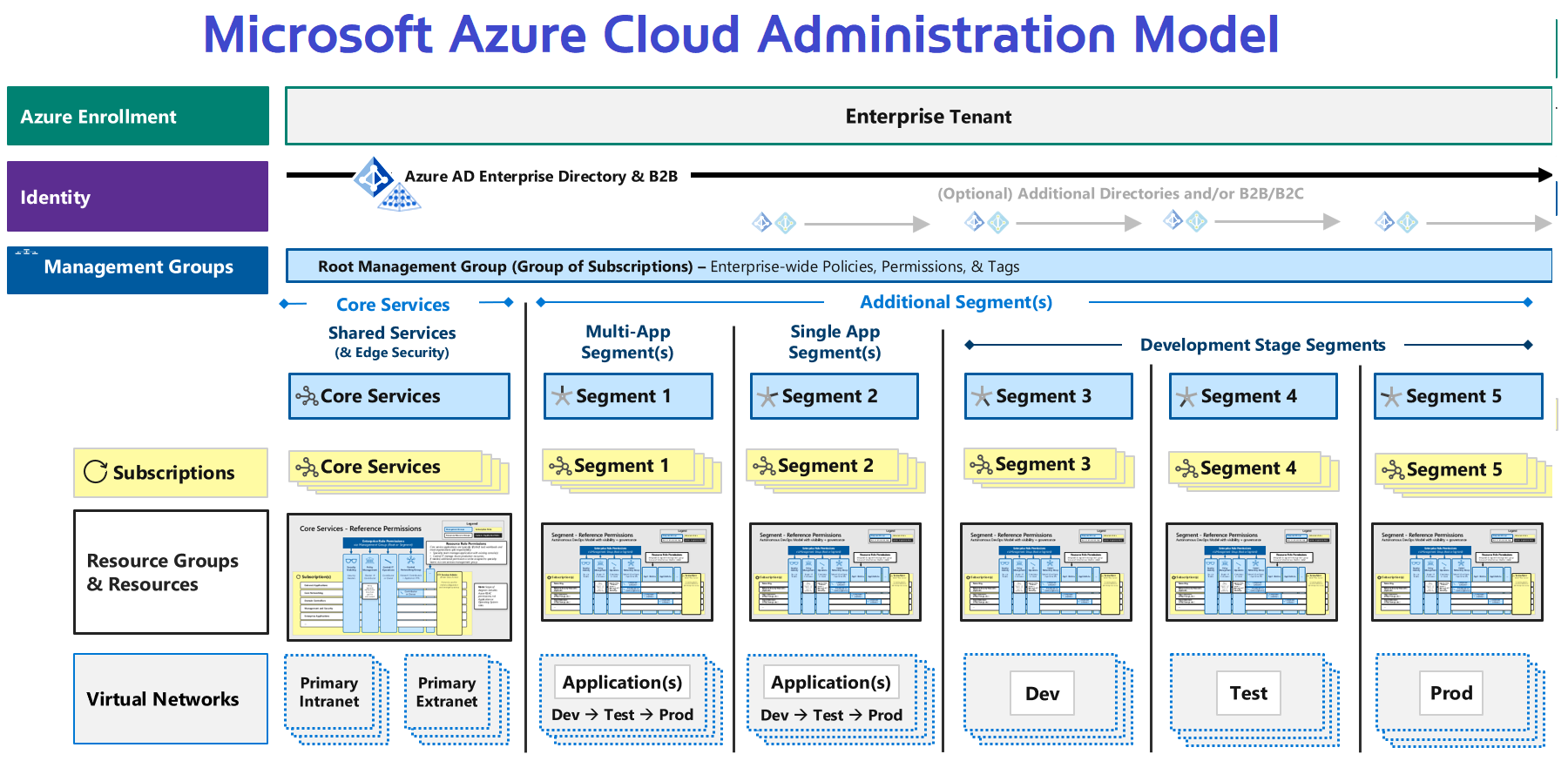
🧩 1️⃣ Azure Enrollment — The Enterprise Entry Point
Every cloud journey begins with Azure Enrollment — the contractual and administrative gateway between your enterprise and Microsoft.
Purpose:
Azure Enrollment defines how your organization subscribes to Azure services and how costs, billing, and accounts are structured.
Key Components:
Enterprise Agreement (EA): Traditional model for large organizations, offering centralized billing and discounts.
Microsoft Customer Agreement (MCA): Flexible, modern alternative for mid-size businesses and CSP-managed customers.
Azure Plan / Subscription Model: Enables allocation of services to different departments, regions, or business units.
Why it matters:
A well-planned enrollment structure ensures you can separate billing, manage costs per department, and scale subscriptions efficiently without creating chaos later.
💡 Tip: Always align your Azure enrollment model with your finance and cost governance strategy.
🔐 2️⃣ Identity — The Core of Access and Trust
Once enrolled, Identity becomes the control layer of your entire Azure ecosystem.
This is where Azure Active Directory (Azure AD) — now known as Microsoft Entra ID — takes charge.
Purpose:
To manage who has access to what resources and how securely.
Core Elements:
Azure AD Tenant: A dedicated directory where users, groups, and enterprise apps live.
B2B (Business-to-Business): Allows secure collaboration with partners using their own credentials.
B2C (Business-to-Consumer): Enables external users (customers) to authenticate securely into apps.
Best Practices:
Enable Single Sign-On (SSO) for unified access across apps.
Implement Conditional Access Policies for device, location, and risk-based authentication.
Adopt Zero Trust principles — always verify, never trust by default.
💡 Identity is the “front door” of your cloud — protect it like your most valuable asset.
🏛️ 3️⃣ Management Groups — The Policy Backbone
When your cloud grows beyond one or two subscriptions, Management Groups bring order and control.
Purpose:
They help organize subscriptions hierarchically and apply governance, policies, and access consistently across the enterprise.
Structure:
Root Management Group: The top-level container for all subscriptions in the tenant.
Child Management Groups: Logical groupings (e.g., by region, department, or environment).
Benefits:
Apply Azure Policies enterprise-wide (e.g., only specific VM SKUs can be deployed).
Assign role-based permissions (RBAC) across multiple subscriptions.
Simplify auditing, compliance, and tagging through inherited rules.
💡 Think of Management Groups as your organization chart for cloud governance.
💳 4️⃣ Subscriptions — The Billing and Isolation Layer
An Azure Subscription is the fundamental unit of organization — where all Azure resources live.
Purpose:
It defines a boundary for billing, access control, and resource deployment.
Typical Subscription Segmentation:
Core Services: Shared network, identity, and monitoring resources.
App Segments: Application-specific environments (e.g., ERP, Analytics, CRM).
Dev/Test/Prod: Lifecycle environments separated for governance and stability.
Why segmentation matters:
Simplifies cost tracking per project or department.
Enhances security isolation between workloads.
Enables different policy sets for production vs. development environments.
💡 Poor subscription planning is the #1 reason for cost and security sprawl in Azure.
🧱 5️⃣ Resource Groups & Resources — The Logical Structure
Inside each subscription, Resource Groups (RGs) act as logical containers for Azure resources.
Purpose:
They group resources that share the same lifecycle, access policies, and deployment context.
Example:
An app may have one RG containing its:
App Service
SQL Database
Virtual Network
Key Vault
Best Practices:
Group resources logically by application or environment.
Use naming conventions and tagging standards for discoverability.
Manage lifecycles — deleting the RG removes all underlying resources.
💡 Resource Groups make management easier — but naming and tagging make it scalable.
🌐 6️⃣ Virtual Networks — The Connectivity Fabric
Virtual Networks (VNets) form the backbone of secure communication across Azure services.
Purpose:
To connect Azure resources privately and securely, just like a traditional data center network.
Typical Layout:
Primary Intranet: Internal corporate access for employees or secure workloads.
Primary Extranet: Partner or supplier access zones with controlled visibility.
Peering & Hybrid Connectivity: Links between VNets, on-prem networks, or other clouds.
Security Focus:
Enforce Network Security Groups (NSGs) for inbound/outbound rules.
Use Azure Firewall or third-party NVA for edge protection.
Integrate with Private Endpoints for PaaS services like Storage or SQL.
💡 Your VNet architecture defines how securely and efficiently your workloads communicate.
⚙️ 7️⃣ Core and Segment Services — Operational Layers
Azure supports separation between Core Services and Application Segments:
Core Services: Centralized shared resources (network, monitoring, security).
Segments: Independent app or business units with separate subscriptions.
Lifecycle Segments: Dev, Test, and Prod — each isolated for security and governance.
This approach allows flexibility while maintaining enterprise-grade control and standardization.
💡 Well-defined segments help balance agility and governance — essential for scaling multi-team environments.
🧭 Why Understanding This Model Matters
For anyone starting their Azure journey — especially new cloud engineers, architects, or governance professionals — understanding this model early is critical.
It helps you:
✅ Plan scalable and compliant cloud environments
✅ Avoid rework due to poor subscription or policy design
✅ Align IT operations with enterprise security and cost objectives
✅ Enable smoother DevOps and automation rollouts later
🏁 Closing Thought
Before understanding Azure services, understand Azure structure.
Governance, identity, and administration are not post-deployment concerns — they’re the foundation of every secure, scalable cloud journey.
The most successful cloud organizations are those that design their administration model first, and build technology on top of it — not the other way around.
Thank you.