

🔐 AI Security in 2025: Understanding the Shared Responsibility Model
Why Every Enterprise Must Rethink How It Secures AI Across SaaS, PaaS, IaaS, and On-Prem

Artificial Intelligence has moved from experimentation to enterprise-wide adoption, but one critical area still remains misunderstood:
👉 Who is responsible for securing AI systems?
As organizations adopt AI across Public SaaS, Private SaaS, PaaS, IaaS, and On-Prem deployment models, the boundaries of security responsibility shift dramatically. Ignoring this can lead to misconfigured systems, data leakage, compliance violations, or unsafe AI behavior.
The framework below (from the attached diagram) clarifies the AI Shared Responsibility Model—a necessary blueprint for CIOs, CISOs, AI leaders, and engineering teams.
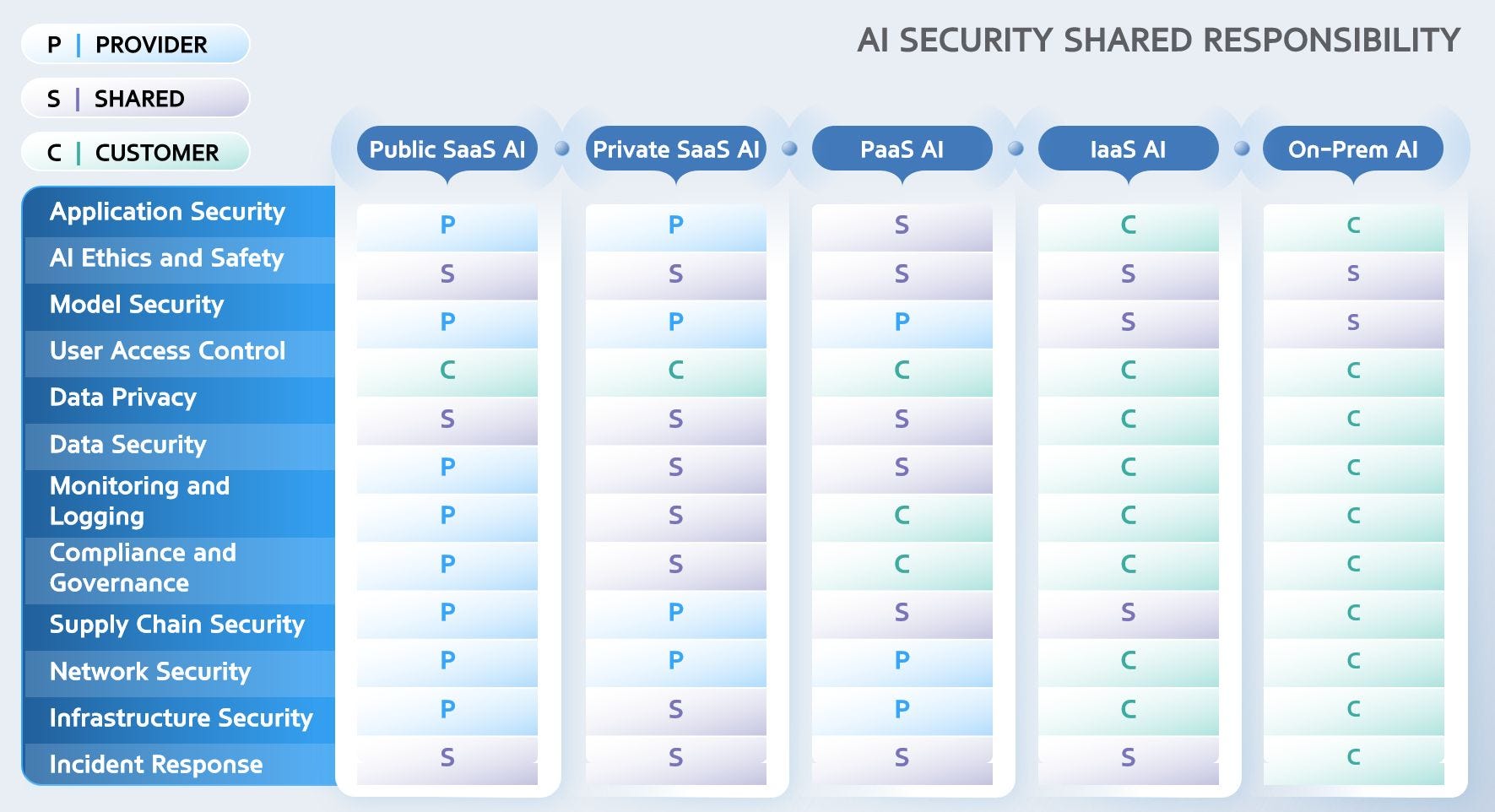
🔎 Understanding the Responsibility Split
Across the five deployment models, responsibilities shift between:
P – Provider (Cloud vendor / AI provider)
S – Shared (Both provider & customer)
C – Customer (Your organization)
This model helps clarify who owns what — especially as AI adoption accelerates.
📊 Key Responsibilities Across the AI Stack
1. Application Security
Public SaaS → Provider
IaaS / On-Prem → Customer
AI-enabled applications need secure coding, vulnerability management, and hardened APIs. As you move toward infrastructure control (IaaS, On-Prem), you own more of this security surface.
2. AI Ethics & Safety
Mostly Shared Responsibility
Ensuring fairness, explainability, safe outputs, hallucination control, and compliance with responsible AI policies requires joint effort between provider and customer.
3. Model Security
SaaS → Managed by Provider
PaaS/IaaS → Customer involvement increases
Model poisoning, prompt attacks, inversion attacks, and unauthorized access must be managed based on how much control your team has over the model lifecycle.
4. User Access Control
SaaS → Provider + Customer
On-Prem → Customer
Identity, MFA, RBAC, API keys, and fine-grained authorization decisions shift toward customer ownership as control increases.
5. Data Privacy & Data Security
PaaS → Shared
IaaS → Customer-controlled
Data governance, retention, anonymization, and privacy-by-design must follow regulatory standards (GDPR/DPDP/CCPA).
As the deployment moves closer to your infra, your accountability increases.
6. Monitoring, Logging & Observability
SaaS → Provider
IaaS / On-Prem → Customer
AI observability (model drift, data drift, security logs, anomalies) becomes a customer obligation in advanced deployment models.
7. Compliance & Governance
SaaS → Provider
PaaS / IaaS / On-Prem → Customer
Customers must ensure AI policies align with internal governance frameworks and new AI regulatory requirements (EU AI Act, NIST AI RMF, ISO/IEC 42001).
8. Supply Chain Security
Mostly Provider-owned except in IaaS/On-Prem
Customers must still validate SBOMs, model lineage, and third-party risks—especially when using open-source or fine-tuned models.
9. Network & Infrastructure Security
Provider → SaaS
Customer → IaaS/On-Prem
Firewalls, segmentation, private endpoints, VCN rules, edge security, and vulnerability patching become customer responsibilities as you move down the stack.
10. Incident Response
SaaS → Shared
IaaS & On-Prem → Customer
AI breach response requires joint action early on, but full accountability shifts to the customer once infrastructure and models are in-house.
🧩 Why This Model Matters Now
AI systems introduce new attack surfaces and require a rethinking of traditional cloud security. Organizations must understand:
✔️ Where your security responsibility ends and the provider’s begins
✔️ How responsibilities change across AI deployment models
✔️ Which teams own which controls (IT, Security, Data, AI, Legal)
✔️ How to build compliance-ready AI environments
Misalignment here is one of the largest hidden risks in enterprise AI programs.
🏁 Final Takeaway
AI security is no longer optional; it is strategic.
And securing AI requires shared responsibility, not siloed ownership.
Enterprises that understand this model will:
✨ Reduce risk
✨ Ensure regulatory compliance
✨ Build trustworthy AI pipelines
✨ Accelerate AI adoption safely and responsibly
Those that don’t are exposed to massive operational, ethical, and compliance risks.